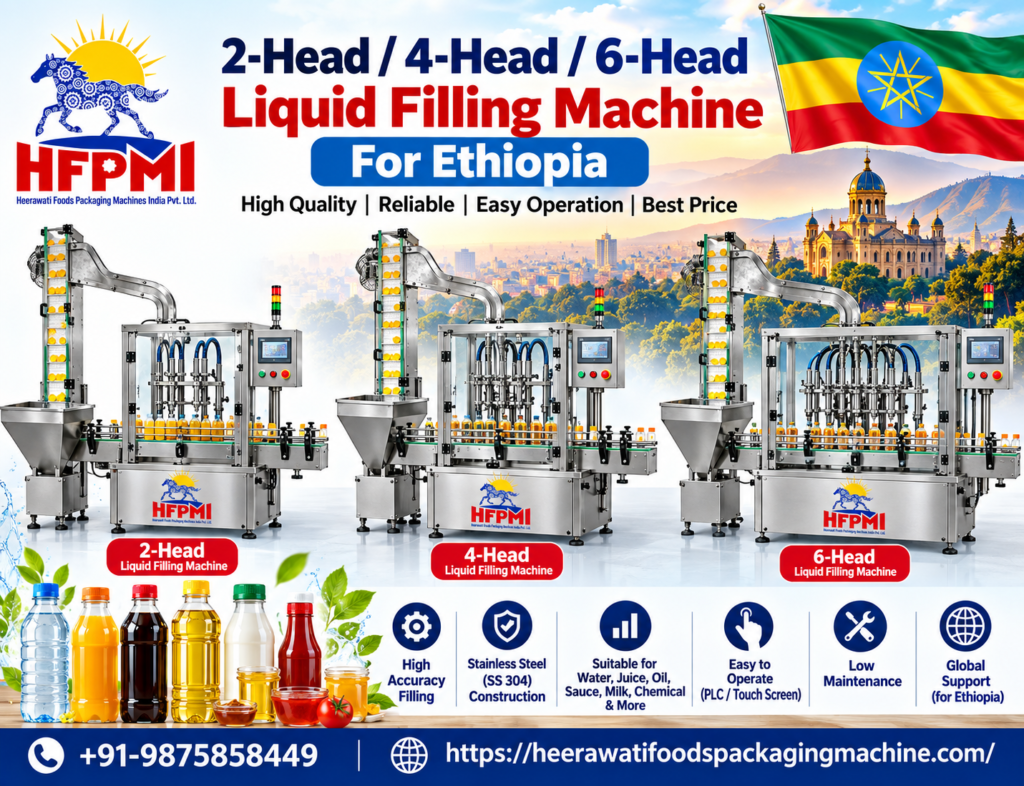
2-Head / 4-Head / 6-Head Liquid Filling Machine in Ethiopia
Manufacturer & Exporter – Heerawati Foods Packaging Machines India Pvt. Ltd.
The demand for liquid filling machines in Ethiopia is growing as food, beverage, pharmaceutical, cosmetic, chemical, and household-product manufacturers increasingly move from manual filling toward accurate, hygienic, and higher-speed packaging systems. For businesses producing products such as edible oils, sauces, liquid detergents, shampoos, handwash, syrups, beverages, and other free-flowing or viscous liquids, choosing the correct number of filling heads can have a major effect on production capacity and operating efficiency.
Heerawati Foods Packaging Machines India Pvt. Ltd., based in Ahmedabad, India, manufactures and exports packaging machinery and can provide liquid filling solutions for customers looking for 2-head, 4-head, and 6-head liquid filling machines for Ethiopia.
What Is a Liquid Filling Machine?
A liquid filling machine is a packaging machine designed to dispense a predetermined quantity of liquid into bottles, jars, containers, pouches, or other suitable packaging formats.
Instead of depending on manual filling, the machine controls the filling operation mechanically or electronically. Depending on the product and machine configuration, filling can be controlled by systems such as:
- Volumetric filling
- Piston filling
- Pump-based filling
- Gravity filling
- Time-based filling
- Servo-controlled filling
The appropriate filling technology depends on the characteristics of the liquid.
For example, a thin liquid such as water behaves differently from a viscous product such as honey or shampoo. Products containing particles, foam, or suspended ingredients may also require a specialized filling arrangement.
For Ethiopian manufacturers, the machine should therefore be selected according to product viscosity, bottle size, required filling accuracy, production capacity, container dimensions, and available utilities.
2-Head Liquid Filling Machine for Ethiopia
A 2-head liquid filling machine is suitable for small and medium-scale production where the required output does not justify a larger multi-head system.
The machine fills two containers simultaneously during a filling cycle. This can provide a substantial improvement over manual filling while maintaining a relatively compact machine footprint.
Suitable applications
A 2-head liquid filling machine may be considered for products such as:
- Cooking oil
- Edible oil
- Liquid detergent
- Floor cleaner
- Toilet cleaner
- Handwash
- Shampoo
- Liquid soap
- Sauces
- Syrups
- Cosmetic liquids
- Lubricants
- Agricultural liquids
- Other compatible liquid products
The exact machine design should be selected according to the product.
Advantages of a 2-head machine
A 2-head machine can be attractive to businesses that are starting production or have moderate daily packaging requirements.
Key advantages include:
- Compact construction
- Relatively simple operation
- Two containers filled simultaneously
- Reduced manual labor
- Consistent filling
- Easy integration with conveyors
- Suitable for small and medium production facilities
- Flexible container-size options depending on configuration
For a growing business in Ethiopia, a 2-head filling machine can also serve as an entry point before upgrading to a higher-head-count automatic filling line.
4-Head Liquid Filling Machine for Ethiopia
A 4-head liquid filling machine provides four filling nozzles, allowing four containers to be filled during each filling cycle.
It is generally appropriate for manufacturers requiring greater production capacity than a 2-head system while still seeking a relatively compact machine.
A 4-head machine may be suitable for:
- Edible oil manufacturers
- Sauce manufacturers
- Detergent producers
- Cosmetic manufacturers
- Liquid soap manufacturers
- Chemical-product manufacturers
- Food-processing companies
- Household-cleaning-product manufacturers
The actual output depends on several factors, including:
- Filling volume
- Product viscosity
- Container size
- Filling technology
- Number of filling cycles per minute
- Operator efficiency
- Container handling system
- Machine configuration
Therefore, head count alone should not be used to estimate production capacity.
Benefits of a 4-head filling machine
A 4-head machine can help manufacturers achieve:
- Higher output than a 2-head machine
- More consistent filling
- Reduced dependence on manual labor
- Better production organization
- Improved filling repeatability
- Efficient use of production-floor space
- Potential integration with automatic bottle handling and capping equipment
For businesses expanding their production capacity in Ethiopia, a 4-head configuration can be considered when the production requirement is beyond the practical range of a smaller 2-head machine.
6-Head Liquid Filling Machine for Ethiopia
A 6-head liquid filling machine uses six filling nozzles and is intended for comparatively higher production requirements.
Six containers can be filled simultaneously during a filling cycle, depending on the machine configuration and operating conditions.
This type of machine can be considered by larger manufacturers and businesses operating continuous or high-volume packaging operations.
Typical industries
A 6-head liquid filling system can be used for compatible products in industries such as:
- Food processing
- Edible oil
- Beverage
- Cosmetics
- Personal care
- Home-care products
- Detergents
- Chemicals
- Pharmaceuticals
- Agricultural products
The filling system must be selected according to the specific characteristics of each product.
2-Head vs 4-Head vs 6-Head Liquid Filling Machine
The main difference between these machines is the number of filling heads operating simultaneously.
| Feature | 2-Head | 4-Head | 6-Head |
|---|---|---|---|
| Filling heads | 2 | 4 | 6 |
| Typical production scale | Small/medium | Medium | Medium/high |
| Simultaneous containers | 2 | 4 | 6 |
| Machine footprint | Generally smaller | Medium | Generally larger |
| Labor requirement | Reduced | Reduced | Reduced |
| Production expansion | Suitable for entry-level growth | Suitable for growing production | Suitable for higher-volume production |
| Automation options | Available | Available | Available |
| Suitable industries | Multiple | Multiple | Multiple |
These categories are general. Actual production capacity must be calculated from the product, fill volume, container, machine cycle time, and filling technology.
Liquid Products That Can Be Filled
Liquid filling machines can be designed for a wide variety of products.
Food Products
Depending on machine design, applications may include:
- Cooking oil
- Edible oil
- Sauces
- Ketchup
- Syrups
- Vinegar
- Liquid food ingredients
- Juice and beverage products
Products with particulates or unusual viscosity may require a different filling mechanism.
Home-Care Products
Liquid packaging machinery can also be used for:
- Liquid detergent
- Dishwashing liquid
- Floor cleaner
- Glass cleaner
- Toilet cleaner
- Fabric softener
- Liquid soap
Personal-Care Products
Applications may include:
- Shampoo
- Handwash
- Body wash
- Hair-care products
- Cosmetic liquids
- Lotion-type products
Viscous products may require piston or pump-based filling systems rather than a simple gravity filler.
Chemical Products
Depending on chemical compatibility and machine construction, filling applications may include:
- Industrial liquids
- Cleaning chemicals
- Lubricants
- Agricultural liquids
- Other compatible chemical formulations
Chemical compatibility is particularly important when selecting contact parts, seals, tubing, pumps, and nozzles.
How Does a Multi-Head Liquid Filling Machine Work?
The exact operating sequence depends on the machine model, but a typical automatic or semi-automatic liquid filling process follows several stages.
Step 1: Container Feeding
Empty bottles or containers are supplied to the filling area manually or through an automated conveyor/bottle-feeding system.
Step 2: Bottle Positioning
The containers are accurately positioned beneath the filling nozzles.
For a 2-head machine, two containers are positioned under the filling heads.
For a 4-head machine, four containers are positioned.
For a 6-head machine, six containers are positioned.
Step 3: Filling
The filling system dispenses the predetermined quantity of product into the containers.
Step 4: Nozzle Retraction
Once the programmed filling quantity is reached, the filling process stops and the nozzles return to their programmed position.
Step 5: Container Discharge
Filled containers move forward through the conveyor.
Step 6: Capping and Further Packaging
Depending on the production line, filled bottles can then move to:
- Capping machine
- Sealing machine
- Labeling machine
- Batch coding machine
- Shrink-sleeving machine
- Cartoning machine
- Case packing system
This allows the filling machine to become part of a complete automatic packaging line.
Choosing the Correct Filling Technology
One of the most important decisions when purchasing a liquid filling machine is selecting the appropriate filling principle.
Gravity Filling
Gravity filling can be appropriate for relatively free-flowing liquids where the product characteristics allow consistent filling through gravity.
Piston Filling
Piston fillers are widely used for products where accurate volumetric filling and handling of more viscous products are required.
They can be suitable for products such as:
- Thick sauces
- Shampoo
- Creamy liquids
- Detergents
- Pastes and semi-viscous products
Pump Filling
Pump-based filling systems can be configured for products where controlled pumping is required.
Different pump types may be selected depending on product viscosity and formulation.
Servo-Based Filling
Servo-controlled systems can provide programmable filling control and can be useful in higher-automation packaging systems.
The right choice depends on the product rather than simply selecting the machine with the largest number of heads.
Automatic Liquid Filling Machine for Ethiopian Industries
Manufacturers in Ethiopia may have different requirements depending on their production scale.
A small producer may require a compact 2-head machine, while a larger factory may require a 4-head or 6-head automatic system integrated with conveyors, capping, labeling, and coding equipment.
An automatic line can include:
Bottle Feeding → Bottle Positioning → Liquid Filling → Capping → Sealing → Labeling → Coding → Collection
Such an integrated system can reduce repetitive manual operations and provide a more organized packaging process.
Liquid Filling Machine for Edible Oil in Ethiopia
Edible oil is an important application for liquid filling machinery.
Manufacturers producing:
- Cooking oil
- Sunflower oil
- Soybean oil
- Palm oil
- Other edible oils
may require volumetric filling systems designed for their specific bottle sizes and production requirements.
The filling machine can be configured around the desired bottle volume, such as small retail packs or larger containers.
When selecting an edible-oil filling machine, manufacturers should consider:
- Filling range
- Bottle shape
- Bottle material
- Required filling accuracy
- Oil viscosity
- Production capacity
- Cleaning requirements
- Automation level
Liquid Detergent Filling Machine in Ethiopia
Liquid detergent is another important application.
Detergent products can have higher viscosity than water and may produce different filling behavior. The filling system therefore needs to be selected according to the actual detergent formulation.
A suitable machine can help manufacturers package:
- Laundry liquid
- Dishwashing liquid
- Floor-cleaning liquid
- Multi-purpose cleaners
- Other household cleaning products
The machine can be integrated with bottle capping and labeling systems to create a complete packaging line.
Shampoo and Cosmetic Liquid Filling
Shampoo and personal-care products can range from relatively free-flowing liquids to highly viscous formulations.
For these products, the filling system should account for:
- Viscosity
- Foaming characteristics
- Bottle opening
- Fill volume
- Product temperature
- Required filling accuracy
- Cleaning requirements
A piston or pump-based filling system may be considered where the product’s viscosity makes gravity filling unsuitable.
Packaging Line Integration
A liquid filling machine does not necessarily need to operate as a standalone machine.
For larger Ethiopian factories, it can be integrated into a complete automatic packaging system.
A typical line may consist of:
1. Bottle Unscrambler
Automatically organizes and supplies empty bottles to the conveyor.
2. Liquid Filling Machine
Fills the predetermined quantity into each bottle.
3. Capping Machine
Automatically places and tightens caps.
4. Induction Sealing or Other Sealing System
Provides an additional seal where required by the product and package.
5. Labeling Machine
Applies product labels automatically.
6. Batch Coding Machine
Prints batch numbers, manufacturing dates, expiry information, or other required information.
7. Shrink-Sleeving or Secondary Packaging
Can be incorporated where required.
8. Cartoning or Case Packing
Prepares finished products for transportation and distribution.
Why Choose an Indian Liquid Filling Machine Manufacturer?
India has a substantial packaging-machinery manufacturing sector serving food, pharmaceutical, chemical, cosmetic, and consumer-product industries.
For an Ethiopian buyer, sourcing machinery from India can provide access to:
- Packaging machinery manufacturing expertise
- Different automation levels
- Custom machine configurations
- Spare-parts support
- Technical documentation
- Export-oriented machinery suppliers
- Installation and commissioning support, depending on supplier arrangements
However, buyers should evaluate machinery based on the actual technical specification rather than country of origin alone.
Heerawati Foods Packaging Machines India Pvt. Ltd.
Heerawati Foods Packaging Machines India Pvt. Ltd. is an Indian packaging machinery manufacturer and exporter based in Ahmedabad, Gujarat, India.
The company can be approached by Ethiopian businesses looking for packaging equipment and liquid filling solutions, including configurations based on:
- 2 filling heads
- 4 filling heads
- 6 filling heads
The final machine configuration should be determined from the product and packaging requirements.
For an export project, buyers should discuss the following information with the manufacturer before ordering:
- Product name
- Product viscosity
- Filling volume
- Bottle dimensions
- Bottle material
- Bottle shape
- Desired production output
- Filling accuracy
- Automation requirement
- Electrical specification
- Available compressed air
- Conveyor requirements
- Capping requirements
- Labeling requirements
- Country-specific installation requirements
How to Select Between 2, 4 and 6 Filling Heads
The number of filling heads should primarily be determined by the required production rate.
Choose a 2-head system when:
- Production volume is relatively moderate
- Floor space is limited
- A compact machine is preferred
- The business is developing its production operation
- Manual loading and unloading are acceptable or planned
Consider a 4-head system when:
- Production requirements are increasing
- Higher output is needed
- The company wants greater automation
- The filling operation needs to be integrated with conveyors and other equipment
Consider a 6-head system when:
- Production volume is comparatively high
- Continuous packaging is required
- The company needs more simultaneous filling positions
- The machine will be part of a larger automatic packaging line
The actual capacity should always be confirmed by the manufacturer using the specific product and container.
Important Factors Before Buying a Liquid Filling Machine in Ethiopia
Purchasing a filling machine is a long-term investment, so technical evaluation is important.
1. Product Viscosity
Always provide the manufacturer with accurate product information.
Water-like liquids and thick detergents may require completely different filling arrangements.
2. Filling Volume
Specify the required fill range, for example:
- 50 ml
- 100 ml
- 250 ml
- 500 ml
- 1 litre
- 5 litres
- Or another required volume
The machine should be selected around the actual production range.
3. Bottle Dimensions
Bottle height, diameter, neck size, shape, and material can affect machine design.
4. Production Capacity
Instead of simply asking for a “fast machine,” specify the required output, such as bottles per minute or bottles per hour.
5. Accuracy
Determine the acceptable filling tolerance for the product.
6. Automation
Decide whether the operation should be:
- Manual
- Semi-automatic
- Automatic
- Fully integrated
7. Cleaning
Products that change frequently or require strict hygiene should be designed around suitable cleaning and changeover procedures.
8. Material of Construction
Product-contact components should be selected according to the product and required hygiene/corrosion resistance.
9. Spare Parts
Before purchasing, clarify the availability and lead time of critical spare parts.
10. After-Sales Support
For an imported machine, confirm:
- Installation support
- Commissioning
- Operator training
- Technical documentation
- Troubleshooting support
- Spare-parts availability
Exporting Liquid Filling Machines from India to Ethiopia
For an Ethiopian buyer purchasing from an Indian manufacturer, the export process normally requires coordination between the machinery supplier, buyer, logistics provider, and relevant customs/import stakeholders.
The exact commercial and import requirements depend on the shipment and current regulations.
A machinery quotation should clearly identify:
- Machine model
- Number of filling heads
- Filling range
- Production capacity
- Machine dimensions
- Electrical requirements
- Power consumption
- Compressed-air requirements
- Construction materials
- Included accessories
- Spare parts
- Packaging
- Delivery terms
- Installation arrangements
- Warranty terms
This information helps the buyer compare equipment accurately.
Technical Consultation Before Ordering
Every liquid product is different. For this reason, a manufacturer should ideally receive a product sample or detailed product information before finalizing the machine.
The following information is especially useful:
Product: Liquid detergent
Filling volume: 500 ml
Container: HDPE bottle
Required output: Example production target
Viscosity: Product specification
Bottle dimensions: Height × diameter
Cap: Screw cap
Automation: Automatic
Country: Ethiopia
Based on these details, the manufacturer can recommend a suitable filling principle, number of heads, nozzle arrangement, conveyor configuration, and additional packaging equipment.
Conclusion
The 2-head, 4-head, and 6-head liquid filling machines provide different production configurations for manufacturers in Ethiopia.
A 2-head liquid filling machine can be considered for smaller or moderate production requirements. A 4-head machine provides additional simultaneous filling capacity for growing businesses, while a 6-head liquid filling machine can be considered for comparatively higher-volume production.
The correct machine should not be selected solely on the number of filling heads. Product viscosity, filling volume, bottle dimensions, required output, filling accuracy, automation level, and the complete packaging process all need to be evaluated.
For Ethiopian manufacturers searching for an Indian manufacturer and exporter of liquid filling machines, Heerawati Foods Packaging Machines India Pvt. Ltd., Ahmedabad, India, can be contacted to discuss the required machine configuration and export requirements.
Need this Machinery for Your Production Line?
Heerawati Foods & Packaging Machinery provides customized turnkey solutions, fast dispatch, and complete on-site engineering support.
Inquire Now for Best Price