
Complete Snacks Packaging Line for Nigeria: Machines, Process & Investment Guide
Nigeria has a growing demand for packaged snacks such as potato chips, banana chips, plantain chips, namkeen, peanuts, popcorn, extruded snacks, and other ready-to-eat products. For snack manufacturers, choosing the right packaging line is important for maintaining product quality, reducing manual labor, improving production speed, and achieving consistent pack weights.
What Is a Complete Snacks Packaging Line?
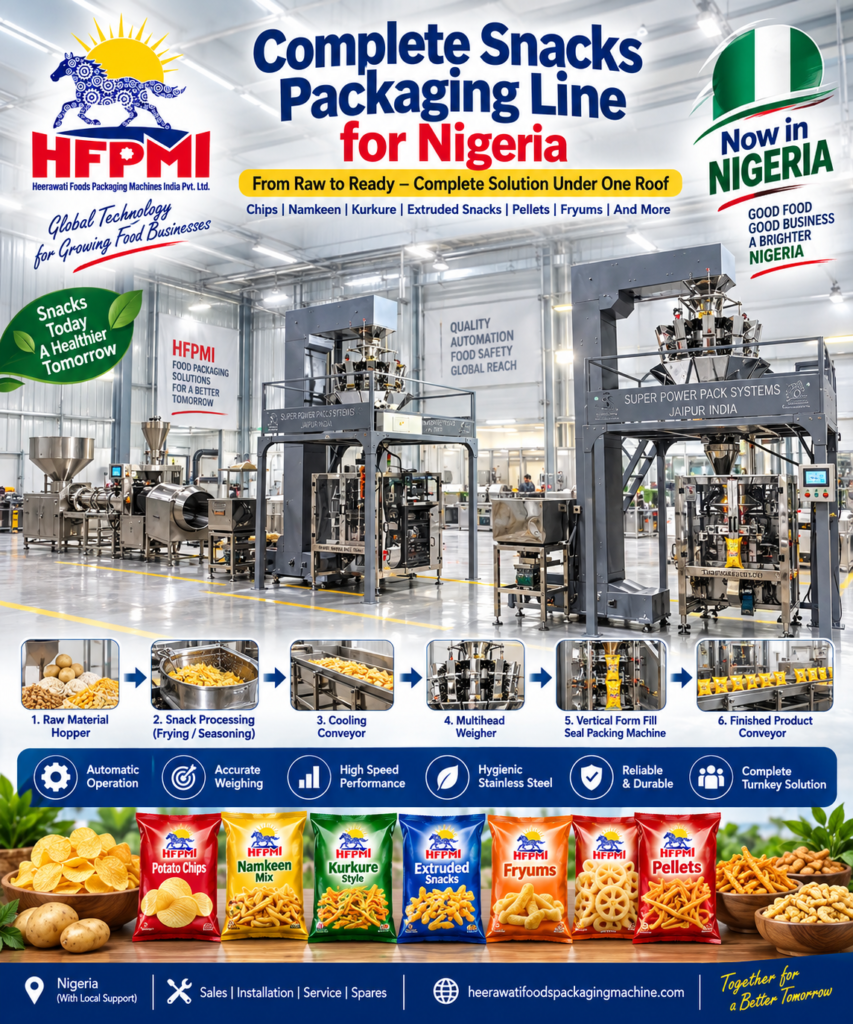
A complete snacks packaging line combines several machines to take the product from preparation through weighing, filling, pouch packaging, sealing, coding, and secondary packing.
A typical line may include:
- Snack Processing Equipment
- Multihead Weigher
- Automatic VFFS Packaging Machine
- Nitrogen Flushing System
- Date Coding / Batch Coding Machine
- Conveyor System
- Pouch Inspection or Checkweigher
- Carton Sealing Machine
- Optional Case Packing Equipment
The exact configuration depends on the type of snack, pack size, production capacity, and level of automation required.
1. Snack Processing Equipment
The first stage depends on the product being manufactured.
For example, a plantain or potato chips line can include washing, peeling, slicing, frying, de-oiling and seasoning equipment. For namkeen or extruded snacks, the processing equipment will be different.
The objective is to deliver a consistent product to the packaging section so that the packaging machine can operate efficiently.
2. Multihead Weigher
A multihead weigher is commonly used for products such as:
- Potato chips
- Banana chips
- Plantain chips
- Namkeen
- Peanuts
- Popcorn
- Extruded snacks
- Mixed snacks
The machine automatically weighs the required quantity before releasing the product into the packaging machine.
This helps reduce manual weighing and can provide more consistent pack weights.
3. Automatic VFFS Snacks Packing Machine
The vertical form-fill-seal (VFFS) machine forms the packaging film into a pouch, fills the measured snack, and seals the package.
Depending on the packaging requirement, manufacturers can produce different pouch formats and sizes.
Common retail pack sizes include:
- 20 g
- 50 g
- 100 g
- 200 g
- 500 g
- 1 kg
The actual range depends on the product and machine configuration.
4. Nitrogen Flushing
Nitrogen flushing is an important option for many fried and oxygen-sensitive snacks.
Before the pouch is finally sealed, nitrogen can be introduced into the package to reduce the amount of oxygen inside. This can help protect the product from oxidation and maintain its texture and quality during storage.
For chips and similar fragile snacks, the packaging system can also be configured to provide an appropriate amount of headspace to reduce product breakage.
5. Batch Coding and Date Printing
A coding machine can print important information such as:
- Manufacturing date
- Best-before date
- Batch number
- MRP or price information where applicable
- Product identification details
The coding method can be selected according to the film, production speed, and customer’s requirements.
6. Conveyor and Product Handling
Conveyors connect different machines in the packaging line and reduce unnecessary manual handling.
A typical arrangement can be:
Weigher → VFFS Machine → Nitrogen Flush → Sealing → Coding → Discharge Conveyor → Checkweigher
This arrangement allows the production process to move continuously from filling to finished pouch.
7. Secondary Packaging
After individual snack pouches are produced, manufacturers may need to pack them into larger bags or cartons for transportation and distribution.
Secondary packaging can include:
- Pouch counting
- Bag packing
- Carton packing
- Carton sealing
- Case coding
- Palletizing
The right system depends on whether the product is being supplied to supermarkets, wholesalers, distributors, or export customers.
Packaging Line for the Nigerian Market
Nigeria has a large consumer market and snacks are sold through supermarkets, local shops, distributors, wholesalers and other retail channels. Packaging equipment therefore needs to be selected according to the manufacturer’s target market and production volume.
For a small or medium-sized snack business, a practical setup may consist of:
Multihead Weigher + VFFS Packing Machine + Nitrogen Flushing + Date Coder + Conveyor
For larger production facilities, additional automation can be added for product handling, inspection, secondary packaging and palletizing.
Important Factors When Selecting a Machine
Before purchasing a snacks packaging machine for Nigeria, consider:
Product: Chips, plantain chips, namkeen, peanuts, popcorn or extruded snacks.
Pack size: The required gram weight and pouch dimensions.
Production capacity: Required packs per minute or kilograms per hour.
Packaging film: Laminated film, polyethylene-based film, metallized film or another suitable packaging material.
Nitrogen requirement: Important for products where oxidation and freshness are concerns.
Electrical specification: The machine should be configured for the customer’s available power supply.
Automation level: Manual, semi-automatic or fully automatic production.
After-sales support: Installation, commissioning, spare parts, operator training and technical assistance are important for long-term operation.
Why Choose an Integrated Packaging Line?
Buying the packaging equipment as an integrated line can make coordination between individual machines easier. It can also reduce manual handling and help manufacturers maintain consistent production.
For a growing Nigerian snack manufacturer, the line can be expanded over time. A business can begin with automatic weighing and pouch packing and later add checkweighing, secondary packaging, case packing and palletizing as production requirements increase.
Heerawati Foods Packaging Machines India Pvt. Ltd.
Heerawati Foods Packaging Machines India Pvt Ltd is an Indian packaging machinery company associated with food and snack packaging solutions.
For Nigerian snack manufacturers, a packaging line can be designed according to the product, pouch size, required output, packaging material and level of automation.
The final machine configuration should be determined after reviewing the product samples, required pack sizes, target production capacity and customer’s site requirements.
Conclusion
A complete snacks packaging line for Nigeria can range from a basic automatic pouch-packing system to a fully integrated production and secondary packaging solution. A typical automatic line combines weighing, filling, pouch forming, nitrogen flushing, sealing, coding and product handling, with additional equipment available for inspection and carton packaging.
For businesses producing potato chips, plantain chips, banana chips, namkeen, peanuts, popcorn or extruded snacks, selecting the correct combination of machines is essential for reliable production and consistent packaging quality.